| The capitol | Matt and Erin arrived in Washington DC a rather later than expected on Sunday 3rd August due to flight delays. (Ed.) Hello, |
| Erin and some globe thing, Hirshorn Sculpture Garden | They have been very this week busy shopping for transport and finally settled on a 1994 Honda Civic Ex. It's a two door coupe with CC, PS, CD and a Sunroof. Low on petrol, and low mileage (for USA anyway) Since the September 11 terrorist attacks in 2001, security has remained high around Washington's key monuments (White House, Capitol, Congress) so Matt and Erin have only been able to see most of them from the outside as they walked from the Lincoln Memorial to the Capitol. They did get to visit the National Air and Space Museum though which Matt said was very good. |
| National Air and Space Museum | They left Washington on Friday 8th August and drove as far as Havre de Grace about 30-40 miles north of Baltimore. (Shown by the blue line.) Then following the yellow brick road :-) (sorry) they drove to New York and spent a couple of days there then on to Boston, followed by Rochester, (They had tickets to a Ben Folds concert there on 17th August.) |
| Car in some state park | From there they headed off to Montreal to stay with Julie. They left Montreal early on the 21st August heading for Niagara Falls and Toronto. From Toronto it will be Chicago, then Minnesota, then the Interstate to Seattle. They expect to have about 40 hours driving from Chicago to Seattle but they're not due in Vancouver until 26th or 27th August so they should be able to spread it out between them. They're looking well aren't they? |
Saturday, 9 August 2003
Washington D.C.


Sunday, 3 August 2003
Jamaica
.jpg) Our flight to Jamaica began with a little excitement, being seated in Row 1, Seats A and B - we thought we'd been upgraded! However once we were lead out onto the tarmac, it became apparent there was no first class on our 30-seater midget plane. There was also an actor seated opposite us. Don't ask me what his name was or what he was in, but I swear it was him! I spent most of the flight trying to catch a glimpse of his luggage tags. Stepping off the flight... well it was basically downhill from there. I had a little trouble through customs, not having written a place to stay on my immigration card (because it was true) and was sent back through the gates by a cross-eyed crossing guard(!), being told I must look up a travel agent and organise a hotel. Knowing Matt had just made up a hotel name on his card, I scrawled the same lie and went through a different gate no worries. Being prepared to be hassled and mobbed in Cuba, and then having it not happen, gave us a little confidence and made us unprepared for the horde of touts, taxi drivers and 'travel advisors' waiting for us at the airport gate. Every person we passed from the gate to the car park, hassled us about our destination and means of transport. Annoyed and with little money on us we settled for the cheapest quote to Negril Beach we'd had yelled at us (I'm talking auction style) and pushed through the crowd to follow the guy to his car. We were lead to the most beat up, patch worked, rickety rust box wagon in the lot (obviously he was cheap but unofficial) and after fondling for seat belts that weren't there (except in the driver's seat), we took off. And boy did we take off! Matt disappeared into the huge bucket seat in the front and with me crouched down in the back, we sped through the streets of Montego Bay and on to Negril Beach. We could tell when the corners were coming up as 'Barny' clasped on his seatbelt, undoing it again on the straights. This especially assured us of his driving skill. The whole trip took about 2 hours, including a short stop for Barny to "Pick something up".
Our flight to Jamaica began with a little excitement, being seated in Row 1, Seats A and B - we thought we'd been upgraded! However once we were lead out onto the tarmac, it became apparent there was no first class on our 30-seater midget plane. There was also an actor seated opposite us. Don't ask me what his name was or what he was in, but I swear it was him! I spent most of the flight trying to catch a glimpse of his luggage tags. Stepping off the flight... well it was basically downhill from there. I had a little trouble through customs, not having written a place to stay on my immigration card (because it was true) and was sent back through the gates by a cross-eyed crossing guard(!), being told I must look up a travel agent and organise a hotel. Knowing Matt had just made up a hotel name on his card, I scrawled the same lie and went through a different gate no worries. Being prepared to be hassled and mobbed in Cuba, and then having it not happen, gave us a little confidence and made us unprepared for the horde of touts, taxi drivers and 'travel advisors' waiting for us at the airport gate. Every person we passed from the gate to the car park, hassled us about our destination and means of transport. Annoyed and with little money on us we settled for the cheapest quote to Negril Beach we'd had yelled at us (I'm talking auction style) and pushed through the crowd to follow the guy to his car. We were lead to the most beat up, patch worked, rickety rust box wagon in the lot (obviously he was cheap but unofficial) and after fondling for seat belts that weren't there (except in the driver's seat), we took off. And boy did we take off! Matt disappeared into the huge bucket seat in the front and with me crouched down in the back, we sped through the streets of Montego Bay and on to Negril Beach. We could tell when the corners were coming up as 'Barny' clasped on his seatbelt, undoing it again on the straights. This especially assured us of his driving skill. The whole trip took about 2 hours, including a short stop for Barny to "Pick something up".  Arriving shaken but safe in Negril Beach, Barny dropped us off at a place he knew was cheap, but good. I toddled off to our hut (basically a box with a verandah and a cold shower out the back), while Matt tried to settle our account. Walking back to the car to get the rest of our stuff I could here Matt yelling at the guy stuff like "That wasn't part of the deal" and "I don't want it!" I peered around the corner to find Barny trying to shove a 'baggie' into Matt's hands and yelling that we owe him about double what he quoted us at the airport. Turned out he was cheap, but tried to make up the difference in extra sales. Needless to say I put on my 'angry eyes', snatched Matt's wallet out of his hand, doled the price we had agreed on into Barny's hands, repeated that we didn't want any and that he should 'go away now' (a little more colorfully than that). Matt grabbed the pack and we hussled back to our hut and slam the door. Very dramatic. I was pretty proud of myself (but glad the windows had bars on them!)
 Later that afternoon (when the coast was clear), we tried going for a walk down the main street to find a supermarket, however even that was an unpleasant experience. Every second car was a taxi driver and they all tried to get your attention by tooting really loudly yelling "Taxi! Taxi!" out the window. Some even swerved off the road in front and behind us to do it! Every shop keeper tried to heard us into their shop and if people weren't trying to sell us something they asked us for money anyway. After stocking up at the supermarket, we scurried back to the hut to make use of our fully equipped kitchen, away from harassment.
 Very tired and uninspired we sat on the verandah, read and played cards all day, and devised harebrained schemes of ways to get the cigars back to Australia. It suited me fine as I was still feeling the after effects of the bug I got in Cuba, but it was a little depressing feeling like we couldn't go any where or do anything even if we wanted to. We couldn't even go to the beach for fear of our tiny pack towels being stolen. We managed the gauntlet one more time up and back from town where I had my hair braided at the market. It wasn't without hassle though. I had enquired about it the day before and not seeing the same lady again, I asked another to do it. The original lady seeing me being set up with someone else, threw a hissy fit and demanded to the women (not me) that I am hers and I should go to her shop. Not wanting to get involved Matt and I stood back as they fought it out, the original lady (blue shirt) winning, so I moved back to her stall. Her, her friend and at one stage a third lady worked on my hair for about 3 hours, while Matt and I continued to read our books and Matt chatted with guy in the stall opposite. After meeting another colorful character on the walk back, namely an 80 year old hippy with a 2 foot machete tied to his belt who felt the need to explain, in detail, where his crop was stashed out in the bush so the cops would never find it, who followed us most of the way back. It was when we returned, that we decided we'd had enough and wanted to fly out early...but we still had the cigars... We'd tried to plain old post them, eliminating plans to use the German guys we met next door to take them back to Germany to post them, or wrapping them up and hiding them in our dirty socks and jocks so the sniffer dogs wouldn't find them, but the day (Friday) was 'emancipation day' public holiday, no post office, so we had to wait until the morning to go back in to town. Early Saturday morning we went back into town, only to discover the post office was still closed. Traipsing back to the hut, we decided to pack up our stuff anyway and head back to Montego Bay. We headed back into town to the taxi rack and sardined ourselves into a taxi with 3 other locals. This ride being the absolute scariest of the whole trip (we've had a few). Again, we didn't even have seatbelts for comfort as the madman overtook on blind corners at 100 doing no less than 140 on the straights, weaving in and out of traffic. The 40km trip took just under 20 minutes (no joke). This taxi only took us halfway though, so we would have to negotiate another once we arrived at Lucea. We should have known we had no choice in the matter as, as soon as we pulled into the taxi rank, another driver had lifted the hatch, taken one pack and ran to his taxi, before we could even blink. Matt running after the pack that disappeared and me demanding his side kick put down my pack (on which I promptly sat) I waited until Matt returned (packless), explaining that the man who had his pack was running a good deal. Resisting the "Don't worry mun" line, Matt was keen to negotiate exact price up front, refusing to get slogged later. I followed Matt to mini bus (fully equipped with movie screen playing the latest James Bond) and we waited until the driver and his side kick had filled the bus and we were off to the airport....slowly. While driving a tropical storm hit. Arriving around 11am, we checked whether the airport post office was open, which didn't exist after all, and so upon the advice of a customs lady we walked from the airport to a DHL office about 10 minutes away. In the rain. A whole lot poorer, but relieved we were rid of the cigars, we walked through ankle deep water in our tevas back to the airport. Missing the last flight to Miami by only half an hour, dowsing our hopes of escaping on standby, we decided to sit out the storm in the airport.
 The storm continued with some of the loudest thunder we have ever heard. Getting late, with no option to sleep in the airport overnight, we decided to high tail it to a hotel. We negotiated yet another taxi, and asked to be taken to the closest, cheapest hotel. The hotel we were dropped at was cheap, however all the cheapest rooms were gone. Matt offered to look for another hotel, while I sat out the front with the packs. Matt trudged through the rain and now very flooded streets (he said up to knee deep in some places.... my hero...) to no avail. He returned, just as the bell hop from the expensive hotel came over to where I was sitting. He gave us directions to 'Ms Foster's house' because she would 'look after us'. With no other option, off we went again. We arrived at 'Ms Fosters' after negotiating the back blocks, to discover she was about 100 years old and ran a missionary next door to the house she was born in. She took "what ever money we can spare" for the room and summoned her black servant to ensure our gas was turned on. Matt went back to the house with our passports, and reported that she lived with another lady, just as old but completely insane (unlike the partially insane Ms Foster) and the house was wall to wall trinkets and books. She twigged that we didn't have the same surname and remarked that they prefer their guests to be married. Matt told her we would be soon! We had some plain pasta for dinner and hit our separate sacks on opposite sides of the room, the alarm set for 4.30am. Packing our packs in the early hours of the morning, we discovered the above creature scurrying across the lino. Once he'd disappeared behind the fridge, we (ironically) walked all the way back to the airport (about 45 mins) in the dark and not hassled. And if you think our troubles are over, think again.....
We arrive at the airport at about 5.15am to discover the storm has knocked out all the power, they are manually processing every passenger, including bag checking and ticket issuing. Unimpressed we line up with the others, having our packs unpacked and repacked and our hand luggage checked three times (very ineffectively due to the fact I later discovered my nail scissors were in my hand luggage and had not one question about the contents of the Cohiba box wrapped in towels and hidden in my luggage). Quite delayed we miss our connecting flight to Washington from Miami and were stuck in Miami until the next flight. We chat with another Aussie bloke who loved Jamaica, later in the conversation discovering he'd stayed in an all inclusive.
If you can afford at least $200US a night, than Jamaica might be a nice place, but from a backpacker's point of view, it wasn't worth the relentless hassle and constant pressure placed on you by the locals. But hey, it's all part of the experience!
Thursday, 31 July 2003
Cuba

After some of our previous flights the 10 or so hours across the Atlantic does not seem too exhausting. As we leave the airport on the outskirts of Havana our taxi driver, who is friendly and speaks a little English, points out things of interest as we whiz past them in the dark. Upon reaching our accommodation the owner, Ana Maria greets us at the gates, she is not expecting us to arrive as it is getting late and I have not communicated with her in some time. She speaks quite good English and introduces us to her husband and son. Ana Maria runs what is known as a Casa Particular, literally a ‘private house’ which is open to tourists as accommodation. In order to do his she is subject to strict government controls (the same strict controls which govern all private enterprise in this last refuge of communism), which include taking all our passport details along with a scrupulous tally of every dollar she takes from us so that the government can then charge her exorbitant taxes (up to 80% in some cases). Despite this heavy taxation the amount of money she earns from letting two rooms to tourists still far dwarves her and her husbands government salaries as high school science teachers. She shows us to our room which is decorated in pink and also has a small kitchen and bathroom as well as a noisy but effective air conditioner.
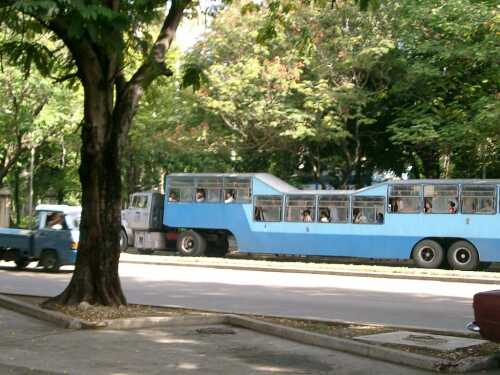 For breakfast the next morning Ana Maria serves us bread (fresh and hot), fruit, fresh juice and scrambled eggs. In a motherly fashion she explains that we should leave our passports at home and not take more money than we need. She also gives us one peso (about six cents) to catch El Camello, the camel (presumably so named due to the shape of the trailer), into Havana Vieja, the old part of the city. The camellos are justifiably described in our guidebook as “jugernaughts,” and are huge bus/truck combinations. A truck engine pulls a kind bus carriage which can apparently hold up to 300 very cramped passengers. Ana Maria says to Erin “you hold on to your bag. And you,” referring to me “hold onto your woman!” Slightly intimidated by the Camello we opt to walk. As we walk we pass stalls set up in the front of people’s houses offering a myriad of products and services; pizza, bread, ice cream, some strange looking drinks, bike maintenance, watch repairs, etc. We also pass buildings with counters or desks inside, some have long queues outside, presumably these provide the state rations. The purpose of some of the other building still mystifies us.
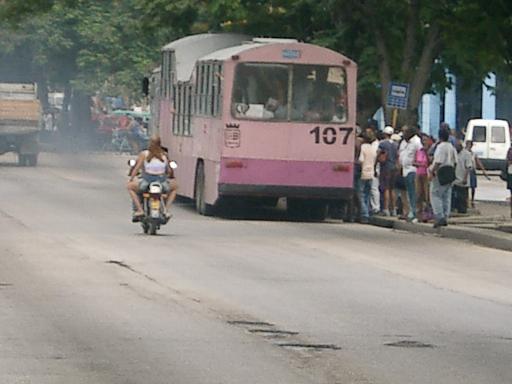 We have a wander round a shopping centre, many of the shops are empty but on the top floor there is an interesting phenomenon. There are four shops, a $1 shop, a $3 shop, a $5 shop and $10 shop. The queue outside the $1 shop is very long, maybe 200 people, and the queues get progressively shorter until there is no queue outside the $10 shop. The shops seem to stock a strange collection of items from chairs and household laundry items to inflatable dolphins and a vast assortment of dust collectors. This seems like an appropriate stage explain the dual economy that exists in Cuba. Cubans who earn a government wage earn Cuban pesos, but Cubans who earn money directly from tourists, earn American dollars. So the people in these shops must earn dollars in some way or trade their pesos in for dollars (26 pesos for 1 dollar). This dual currency situation provides Cuba an excellent mechanism for extracting far more money from tourists than from Cubans for identical products. For example, an ice cream bought from a street stand in Central Havana (a poorer non tourist area) costs 1 peso (about four US cents), where as an ice cream bought from a tourist stand in Havana Vieja costs US$2.50, 65 times more! However, many items are simply not available for purchase in pesos, so most Cubans, who don’t have dollars, live a class below those who do. To make the whole currency issue more confusing there are also convertible pesos, these are locked to the value of American dollars but worthless outside of Cuba.
 As we walk past the capitol building, ironically a replica of the American capitol, we are hassled for the first time by a jintenero. We have had extensive warning about these people who try to sell you anything and everything including cigars, hotel rooms, rum, restaurants and women. On the whole though, these people turn out to be pretty harmless and easy to get rid of. The penalties for hassling tourists can be very strong, so this too helps dissuade them. Past the capitol we walk along narrow streets with old buildings on either side. The paint is peeling from most of them and they have big cracks down the facades. People stand in doorways talking and children run down the street playing. We emerge into the open again, Museo de la Revelución. Starting on the top floor we wind our way down through rooms full of Cuban history. The English translations are inconsistent and we get quicker as we go, but there are some quite interesting pockets of memorabilia and information. In the park out the back, the Granma (the ship the revolutionary forces landed) lives in a huge glass enclosure surrounded by tanks and armored cars from the revolution (many complete with bullet holes). Also of interest in this part of the museum are the remains of the American B52 bomber that was shot down during the failed Bay of Pigs invasion. For years the US refused to admit it had lost a plane so the Cubans stored the pilot’s body. When they finally admitted they had lost a pilot, some 15 years later, the Cuban’s returned the body. Strange!
 Outside the museum another couple sits down next to us on the step and we get talking. Gwen is from France and Loucas is from Cyprus, they have recently married and this trip is a honeymoon of sorts for them. Furthermore, they have hired a car for a number of days and invite us to join them, so we arrange to meet them the morning after next. From the museum we walk back through the narrow streets. In the fronts of some of the houses there are small art galleries which sell local artworks. We walk past a fort like building which seems to house some kind of police headquarters and on to a Havanan main street market.
Another day and another beautiful breakfast is served to us before we set out walking again, this time to the Plaza de la Revolucion. On one side of the plaza is the monument to the original Cuban revolutionary hero Jose Marti, who initiated the revolution against Spanish Colonial rule only to be killed in the first battle. Otherwise he would have almost certainly become Cuba's first president. A large statue of Marti sits behind a large Cuban flag and in front of a huge 139 metre marble steeple. In front of the monument is the podium from which Fidel Castro performs his infamous speeches to the crowds who mass into the bleak square below. On the opposite side of the square is a monument to Cuba's other famous revolutionary hero, Ernesto 'Che' Guevara. Attached to the side of a large anonymous government building is a steel replica of the famous photo of Che. We pose for photos before walking down the Passeo toward the waterfront. As a richer area during the American influenced 20's and 30's, the street is lined with many large mansions, most of which are falling (or have already fell) into disrepair. Ana Maria has suggested we visit a noticeable exception, which has been restored over the past few years. She explains to us the Romeo and Juliet style story of the mansions original owner, and shows us a profile of the house which has appeared in a Slovenian lifestyle magazine (apparently Cuba is rather popular with the Slovenians!). Unfortunately when we try to visit we are confronted with a confusing array of people who eventually explain that the building now functions as headquarters for a hotel chain and it is not possible to visit (at least I think that was the gist of the conversation!).
 The waterfront (the Malecon) is actually quite grey and bleak. There are a few tall expensive looking hotels in their own compounds, a four lane road, the concrete seawall and the waves crashing onto the sharp rocks behind. We have a look around a small market where Erin buys a bracelet made of wooden beads. Alongside the road facing the Florida Straight is a billboard picturing a Cuban revolutionary shouting across the sea at an enraged Uncle Sam, he yells: "Mr. Imperialists, we have absolutely no fear of you." As it starts to rain we take shelter in a restaurant for lunch, "Restaraunte de Amore." Big mistake, it is tacky as all hell, the music is terrible and all over the walls there are clichéd pictures of loving couples. Furthermore the food is ordinary and the service shoddy, but at least it keeps us out of the rain! We wander around to the Hotel Libre to try and get some money and confirm our flights, but the bank has closed for the day already and the Air Jamaica office has moved to another hotel. So we go to the very posh Hotel Nacional to get money instead, wondering just how much of Cuba the prisoners of these hotels really get to see.For dinner Ana Maria recommends a paladar named the Blue Ferret (a privately owned restaurant that is run from the front of a house. ‘Paladar’ is to restaurant as casa particular is to hotel). The staff are friendly and the food delicious, a stark contrast to the state run option experienced earlier in the day. I have roasted banana wrapped in grilled pork and rice with black beans and Erin has sweet and sour chicken with vegetable rice.
 The next morning we have organised to ride with Gwen and Loucas, and after another fresh breakfast Ana Maria leads us out to the car and gives Gwen instructions to drive carefully. We have left one pack with Ana Maria, which proves to be lucky as our remaining pack only just fits in the back of the VW Golf with Gwen and Loucas'. As we drive out of Havana we pass underneath what I think is the right road (in this case the autopista to Pinar del Rio), I mention this to Gwen, Loucas agrees, we stop a couple of times for Gwen to ask directions. The autopista is mayhem, people on bikes, foot, horse, horse and cart, bus, truck, camello, tractor and speeding car. The road is a patchwork with no lines and some big potholes, it decays at the edges. At each intersection, and there are many, people stand trying to get a ride, piling onto the top of trucks or tractors, whatever. To make things worse there are people selling things all along the road, in the middle of nowhere. And when I say selling things- that typically means lunging at you with onions, or butter or whatever they’re selling, while you are speeding past at 100 km/hr.
 Remarkably we find our way to Viñales, which sits in a valley surrounded by steep hills, covered with lush vegetation and often flanked with high cliffs. We locate the house of Oscar, who Ana Maria has recommended to us. He has two pleasant double rooms, Gwen and Loucas take the one upstairs while we take the one in a separate block out the back. Across from our room is a little area where there are some rocking chairs and a dinner table, it is open on one side and there are climbing posters on the wall (Viñales is the Cuban climbing area, and while Oscar is certainly no climber himself, he generally hosts visiting climbers from overseas)! After sitting at the table to discuss our plans we head for Las Cavernas de Santo Tomas, about 20km from Viñales. However, when we get there we are told that the caves will be closed for at least a month because of a collapse (at least we think that’s what the woman said). This is a shame because our guidebook describes them as the best caves in the area and they seem to be a bit off the tourist bus trail. Instead we head for Cavernas del Indio, which are firmly on the tourist bus trail. We pay $5 to share to the short walk and even shorted boat trip through the rather unremarkable caves with a bus full of Italian and English tourists.
 Back in Viñales we wander along the main street which is refreshingly untouristy and nicely lined with tall pine trees. We visit a small blue church in a square and buy some peso ice-cream. For dinner Oscar serves Loucas and I pork and Erin and Gwen chicken, plus an assortment of vegetables. It’s a good meal. After dinner Gwen is not feeling well so they go to bed leaving Oscar, Erin and I to sit and talk for an hour or two. This is no mean feat, for Oscar speaks no English and my Spanish is limited at best. But with Erin’s help dictionary in hand, a fair amount of charades and an impressive amount of patience on Oscars behalf we manage. Oscar must be in his mid forties and is clearly well fed from his build (Gwen is obsessed with the size of his stomach). He lives with his wife and an assortment of extended family. He explains that it is difficult for Cubans to leave Cuba, but that he likes his lifestyle in Viñales anyway. He seems to have some knowledge of life outside of Cuba through the variety of people who stay with him. He seems happy, but he is clearly amongst the more fortunate of Viñales’ residents, having the opportunity to sell his hospitality has also brought the kind of wealth that most of his neighbours would not get the opportunity to see.
We are woken early by the squeals of a pig, most likely unhappy because it knows that today is the day of the revolution and as such, it’s dinner. After the pig is done the dogs, roosters and other members of the vast menagerie take their turns. Today we decide to head for Cayo Jutias, a small island with a beach on Cuba’s northern coast. First we end up in a small village by the beach, and then along a bumpy and neglected road that follows the rough path of the coast.
.jpg) On the way we pass a rental car coming in the other direction, driving along with a flat tyre. We stop and try to help, but they can’t locate a special security wheel nut attachment designed to prevent the wheels from being stolen (coincidentally, the couple with the flat were in front of us in line coming through customs- the guy borrowed Erin’s pen to fill out his slip!). A passing car full of Cuban men stops and one of them locates the security nut thing, which is kind of ironic because this means that the very people the hire company are convinced are going to steal the wheels are the only people who can actually get them off! Further along the road we pass through another small town with some big factories. All of the factories like this that we pass everywhere in Cuba look run down and dormant, once upon a time they must have been full of workers slaving eagerly for their country, but now it seems the bubble has burst and their enthusiasm has waned.
On the way we pass a rental car coming in the other direction, driving along with a flat tyre. We stop and try to help, but they can’t locate a special security wheel nut attachment designed to prevent the wheels from being stolen (coincidentally, the couple with the flat were in front of us in line coming through customs- the guy borrowed Erin’s pen to fill out his slip!). A passing car full of Cuban men stops and one of them locates the security nut thing, which is kind of ironic because this means that the very people the hire company are convinced are going to steal the wheels are the only people who can actually get them off! Further along the road we pass through another small town with some big factories. All of the factories like this that we pass everywhere in Cuba look run down and dormant, once upon a time they must have been full of workers slaving eagerly for their country, but now it seems the bubble has burst and their enthusiasm has waned. The final causeway to the island is quite spectacular with swamps on one side and extensive views along the coast on the other. The beach itself is quite narrow with some thatch roved bathrooms and bar at one end and the decaying remains of a road stretching partway along. Past the road we find a nice spot under a tree. I swim one or two hundred metres out to a reef to do some snorkelling. The coral is not spectacular (although there are some impressive brain corals), but the fish are quite pretty, lots of different colours and shapes. When I hear thunder I head back to shore (longer than I remembered on the way out!) and we walk back to the bar for a mohito. We drive back to Viñales through some impressive thunderstorms. We have an ordinary pizza at an outdoor bar near Oscars. We had planned to see the cabaret in Pinar del Rio, but as Gwen and Erin are not feeling too well, we settle for a few hands of cards instead. When Gwen and Erin go to bed, Loucas and I sit up drinking some of the Cuban liqueurs we have bought and chatting. He has a degree in international economics and has worked for some interesting organisations, but now has taken over the family travel agency in Cyprus.
.jpg) The next morning starts as the previous except this time the dog beats the pig to it. At this stage (5am), it becomes apparent that something has disagreed with Erin and I’s digestive systems. After taking some Gastro-stop we manage to get a couple more hours of napping in between pig outbursts. Late morning we set out for Cienfuegos, back past Havana. On the way we head for Cueva de los Portales where Che Guevara and an assortment of Russian and Cuabn army personnel had their headquarters during the Cuban Missile Crisis. The caves are now situated in the grounds of a holiday camp, and music blares at full volume from the speakers near the entrance of the cave. Only once we are in the caves can our English speaking guide be heard. The caves are quite large and despite the large entrances, quite well hidden by the surrounding vegetation (jungle). Apparently the Cubans could see the American planes flying overhead, but the Americans never spotted them. The guide was good, describing for us what each area was used for; communications, meals, high level meetings and the small bunker where Che and other higher ranking people slept. The $1 each that the guide charged us made this expedition far better value than the Cavernas del Indio.
The next morning starts as the previous except this time the dog beats the pig to it. At this stage (5am), it becomes apparent that something has disagreed with Erin and I’s digestive systems. After taking some Gastro-stop we manage to get a couple more hours of napping in between pig outbursts. Late morning we set out for Cienfuegos, back past Havana. On the way we head for Cueva de los Portales where Che Guevara and an assortment of Russian and Cuabn army personnel had their headquarters during the Cuban Missile Crisis. The caves are now situated in the grounds of a holiday camp, and music blares at full volume from the speakers near the entrance of the cave. Only once we are in the caves can our English speaking guide be heard. The caves are quite large and despite the large entrances, quite well hidden by the surrounding vegetation (jungle). Apparently the Cubans could see the American planes flying overhead, but the Americans never spotted them. The guide was good, describing for us what each area was used for; communications, meals, high level meetings and the small bunker where Che and other higher ranking people slept. The $1 each that the guide charged us made this expedition far better value than the Cavernas del Indio..jpg) I sleep most of the way to Havana and when I wake up we are at the end of the autopista. Gwen thinks we are driving north whilst Loucas and I think we are going south , I’ve been sleeping so we get out a compass to get back on the right track. We find the next autopista and after about six hours of driving and lots of direction asking, we finally arrive in Cienfuegos and take a nice room overlooking a park and the bay. For dinner we go to a restaurant down the street and have some awful seafood paella (Erin’s first meal in days) which does not help our fragile state. As we eat, cats climb through the window (which overlooks the bay) and scrounge for scraps. We watch the speco electrical storm taking place across the bay while waiting for the bill.
I sleep most of the way to Havana and when I wake up we are at the end of the autopista. Gwen thinks we are driving north whilst Loucas and I think we are going south , I’ve been sleeping so we get out a compass to get back on the right track. We find the next autopista and after about six hours of driving and lots of direction asking, we finally arrive in Cienfuegos and take a nice room overlooking a park and the bay. For dinner we go to a restaurant down the street and have some awful seafood paella (Erin’s first meal in days) which does not help our fragile state. As we eat, cats climb through the window (which overlooks the bay) and scrounge for scraps. We watch the speco electrical storm taking place across the bay while waiting for the bill.In the morning there are no pigs or dogs, only rooster and even they wait until a respectable hour. Mandy, the casa’s owner, it turns out is chef (he used to work for one of the biggest hotels in Cuba), and he serves us a delicious breakfast, including some strange fruit (green outside, red with pips inside) and some lovely eggs with tomatoes. As we compliment him on his cooking he remarks that we should have stayed and eaten with him last night, yeah, way to rub it in!
.jpg) A bit before midday we visit Palacio del Valle which looks Cuban/European/Indian. All around the palace the ceilings, walls and doorways are covered in intricate carvings. The floors and staircases are all marble and we sit on the roof drinking mohitos overlooking the bay while the band plays just for us. Erin and Gwen both buy one of their CDs so their investment in us was a worthy one. When their manager comes upstairs to give them their paycheques I sneak a peek and understand why they are so happy to have sold a couple of CDs. We drive to the middle of Cienfuegos and walk up the main street. The square is quite pretty, nicely treed and flanked on all four sides by colonial era buildings.
A bit before midday we visit Palacio del Valle which looks Cuban/European/Indian. All around the palace the ceilings, walls and doorways are covered in intricate carvings. The floors and staircases are all marble and we sit on the roof drinking mohitos overlooking the bay while the band plays just for us. Erin and Gwen both buy one of their CDs so their investment in us was a worthy one. When their manager comes upstairs to give them their paycheques I sneak a peek and understand why they are so happy to have sold a couple of CDs. We drive to the middle of Cienfuegos and walk up the main street. The square is quite pretty, nicely treed and flanked on all four sides by colonial era buildings. The Main Square in Cienfuegos
.jpg) Our room in Trinidad (note the flag on the wardrobe)
Our room in Trinidad (note the flag on the wardrobe).jpg) Next we head for Trinidad further along the coast, this time when we stop for directions the guy asks if we have room for him. It proves an effective way of having on the spot directions. We drop Michelangelo at his house and try and find somewhere to stay. Nowhere has two double bedrooms available and Gwen gets a bit worried about not finding anywhere and takes the first place she finds. Erin and I walk up the street a bit and take a much nicer place, with a huge room, beds for five, high ceilings and a cupboard made from different coloured woods including a Cuban flag in the top (it would be worth a bit anywhere else in the world - worth a jail term the American guy staying out the back comments). Despite yet more offers of lobster for dinner we opt for the chicken which is OK but not as nice as at Oscar’s. After dinner we go and sit on the steps outside ‘Casa de la Musica’ in the main square. The square lies below the church with a fenced area and some trees. Many of the streets are cobbled with brightly painted decaying old houses on either side. It makes me wonder what UNESCO hope to achieve by maintaining Trinidad, but not maintaining it also. Half way up the stairs a band is playing, leaving space in front for dancers to show off their stuff. Intimidated by the talent, we opt to watch.
Next we head for Trinidad further along the coast, this time when we stop for directions the guy asks if we have room for him. It proves an effective way of having on the spot directions. We drop Michelangelo at his house and try and find somewhere to stay. Nowhere has two double bedrooms available and Gwen gets a bit worried about not finding anywhere and takes the first place she finds. Erin and I walk up the street a bit and take a much nicer place, with a huge room, beds for five, high ceilings and a cupboard made from different coloured woods including a Cuban flag in the top (it would be worth a bit anywhere else in the world - worth a jail term the American guy staying out the back comments). Despite yet more offers of lobster for dinner we opt for the chicken which is OK but not as nice as at Oscar’s. After dinner we go and sit on the steps outside ‘Casa de la Musica’ in the main square. The square lies below the church with a fenced area and some trees. Many of the streets are cobbled with brightly painted decaying old houses on either side. It makes me wonder what UNESCO hope to achieve by maintaining Trinidad, but not maintaining it also. Half way up the stairs a band is playing, leaving space in front for dancers to show off their stuff. Intimidated by the talent, we opt to watch. Today we plan to head for Santa Clara, but first we decide to head to Playa Ancón (a beach) for a little while. It is quite picturesque with a wide beach and plenty of palm trees, but it is clear that the hotels which are springing up will soon dominate. The road toward Santa Clara (which is inland), is quite steep and Gwen makes me nervous in places by attempting to take run-ups at hills. At one stage we have to get out and walk a short distance because the car can’t make it up a steep section with us all in it. We attempt the previous days tactic and take on a navigator, he is very friendly and the girls are most impressed by his companion, Rocky, his three year old son. We talk (as best I can) for about ½ and hour before our tactic fails, he is not going all the way to Santa Clara, he asks to be dropped off at a house beside the road. With more directions we make it to Santa Clara where we have planned to get the bus back to Havana for our flight, while Gwen and Loucas travel further to some islands on the north coast (more in the style of a honeymoon). Finding the bus station we have a choice between a late night bus and an early morning bus, opting for the later Gwen and Loucas drive us around to find a place to stay and we say our farewell (after we leave it occurs to me that we have no photos of the four of us, which is why you wont see one!). We have a brief walk around Santa Clara which is unremarkable and quite dirty (I suppose that’s a remark, but anyway!). We negotiate a ride to the Che memorial (pretty much the only reason why Santa Clara is on the tourist circuit) on a bicitaxi belonging to an ancient old man. We see the statue but the city has no power and as a consequence the museum beneath is closed. When we get back to the centre of Santa Clara I give the man a hefty tip in the hope he can retire soon! The power returns at about eight.
 In the morning the taxi driver drops us around the corner from the bus terminal because he’s not really a taxi driver and could get in trouble for carrying us. Every time you spend dollars anywhere that is actually allowed to take your money, they write it down, even if its only 50 cents. If they don’t write it down and pay the tax accordingly (which is often very high >80%, limited private enterprise, Communist country, etc.) then they can be shut down. On the advice of the casa owner we enquire about taxi prices, rather than taking the bus. The shared ride (four passengers in the car) back to Havana (260ish kilometres away) costs us a little more than half what the bus would have cost. What’s more it only takes about the half the time, very strange. Back at Ana Maria’s, Mercedes, the housekeeper, lets us in and we head straight back out to the tobacco factory. The guidebook says tours are available, but on arrival some touts tell us that they’re not and the security guards seem to agree. Instead we follow a big guy upstairs so he can sell us some fake cigars. We go up a set of stairs, around a balcony and into a back room. The door is closed, a curtain is drawn behind us and the goods are brought out from their various hiding places. At first I’m a little nervous, but I settle a bit. (Erin is very unimpressed). After some inspection and pretending we know what we’re on about, (to an audience of three big guys and 2 eager women), we buy some fake Cohibas and get out of there (we pay about a quarter of the Cuban shop price and about an eighth of the overseas price, granted their fakes, but good fakes I’m told!). Next we head for the rather less intimidating Museo Bella Artes. Over the course of a couple of hours we visit just one half of the museum, the Cuban half. There are some interesting works, especially from the later years across a range of mediums. I notice there are antigovernment pieces that predate the revolution, but no recent ones. It seems that Castro cannot be criticised, well, from prison or exile maybe. Everywhere we go there are billboards praising the revolution and selling government propaganda. Nowhere is there a billboard promoting private enterprise. The country is scattered with ambiguously named public buildings like “The Centre for Information” and “Ministry of Propaganda” (well maybe I made the last one up). After the museum we head back to the pizza place we had visited the first time. After attempting to find a post office and do a little poster shopping we finally manage to negotiate a taxi to take us home through the rain. Ana Maria lets us cook some pasta in her kitchen and organises a taxi for us for the morning.
Up early, Ana Maria gives us some juice and we say our farewells. She genuinely welcomed us into her house and did a great deal to make out stay enjoyable, we were very lucky. One last idiosyncrasy to go with all the other things I still don’t understand, the 15 minute taxi ride to the airport costs us more than the trip to Havana from Santa Clara. Go figure!
Tuesday, 22 July 2003
Barcelona
 Still half asleep we get off the train in Barcelona and negotiate our way on the metro to the Barri Gotic region, which is one of the older parts of Barcelona. This region is also where our guidebook says there is a selection of cheaper accommodation options. We wander for quite a while from full hostel to overpriced hostel before we eventually take a marginally overpriced boxy second floor room, with a tiny balcony overlooking the street.
The next day morning we stop for breakfast at the delicious bakery downstairs. Almost every meal involved something from here; they have a dazzling array of unhealthy products to sample. From here we walk through the narrow streets of Barri Gotic to the Museu de Historia (or something like that). This museum contains underground archeological excavations dating back to before Christ. You can walk on gangways through them and they have signs depicting what each area may have looked like in its day, quite interesting. After this we head to La Segrada Familia, as I've already described in an email:
"La Sagrada Família is Gaudi's half finished masterpiece. They started working on it in 1896 and the current expected date of completion is 2041!! There are no photos from France, the only one we have is of the inside of the train station and one from the boat in the harbour, neither are very good.
Tonight we are going to watch a light show at some fountains in one of the parks, and then we might go see some Jazz. Tomorrow we are going to see some more Gaudi stuff and try and sort out the camera debacle.
 In the evening we are too tired to head for the light and magic thing. For dinner we have a selection of tapas, which are small meals generally eaten while in combination with alcohol consumption. One is a beautiful mushroom and tomato mix of which we have a couple of serves.
This morning is spent doing chores, washing etc, and then back onto the Gaudi trail to Parc Güell. Originally intended to become a housing estate; the funds dried up and ownership of the park eventually passed to the local government. The most striking features of the park include an open air plaza which forms the roof of a market place supported by about 80 large stone columns.
Gaudi also kept with his nature thing here, with raised pathways supported by tree like columns and a covered walkway in a wave formation (pic). Also present are some impressive mosaic artworks (pic). For dinner we buy some stuff from the local produce market before heading to the magical fountain thing. Unfortunately I haven't read the guide book well enough and it’s just a pond on Mondays, it’s quite nice though. Atop the hill, overlooking the fountain lined boulevard and the large plaza containing a massive statue is a large (poorly lit) palace.
 Our last morning in Barcelona is spent (after picking up my camera from repairs way out in some industrial estate) at the Picasso museum. The museum houses a vast array of the artists work from every period in his life, from an early age through to his last years. I especially like one from the blue period of a flower in a glass (yes, I’m sure it has a name!), but I am a little disappointed to discover that Guernica is not housed here (both Erin and I studied it at school).
 From the Picasso Museum we negotiate the metro once more and arrive for our flight running a little behind schedule. I have some items I have to send home and we hurriedly organise postage for this, which is made all the more difficult by the fact I haven't got enough Euros left. When we finally sort out funds and pay the hefty price we are running late for boarding.
But it gets worse still, when in my rush to get to the gate I lose Erin. When I finally manage to explain to the gate staff in my poor Spanish that I have lost my partner, one of them heads of to look for her (and call her over the PA in Catalan and Spanish, very useful hey?!) whilst the others try and tell me she has stopped to shop. A little upset, Erin finds her way and we are off to Cuba!

Friday, 18 July 2003
Corsica
After a rather expensive petite déjeuner [breakfast - Ed] by the marina in Bastia we boarded the tiny diesel (and also rather expensive) train toward Calvi.
After more time spent standing in the heat (an emerging trend) at some obscure station in the middle of Corsica where the lines meet, we finally chugged over barren boulder strewn hillsides for the final section of track that winds its way along the north coast just above the white sandy beaches and turquoise waters. These same waters lulled us and we opted for the late bus to Calenzana so we could spend the afternoon at the beach.
 After an early rise, a slow start and some phone calls home we eventually started up the GR20's first étape [stage - Ed] at around 8:30, so far as I could tell we were the second last lot of people to start for the day (they don’t hang around!).
We were expecting a rough start; the first day climbs over 1400m with a total ascending (adding the downs back in) of over 2000m, more than sea level to the top of Mt Kosciusko. As we stopped for one of many breathers on the way up the hill a French man, probably in his fifties, who had just completed a full 14 days from the other direction, remarked "it is good that you come all this way to see our Corse."
As we stopped for another rest on the second high pass the clouds cleared and we could see the impressive (but comparatively small) Monte Grossu, its dark cliffs towering over the cloud filled valley below.
As we sat (yes, yet another theme occurring here!) on the next gap a herd of goats passed through, probably more than a hundred with long coats, big horns and sturdy footing! We looked on jealously!
After climbing further still we could finally see the refuge on the horizon. 11 hours after leaving Calenzana we finally plonked our bags down outside the refuge, the book had recommended we do it in 6 and a bit hours plus 10% for breaks, hmmm!!
 The next day we decided to take the low level route down the Melaghia River and back up the Figarella Valley, rather than another day over high passes. The walk down the first valley passes easily in the early morning shade, and we stop for lunch on the boulder-strewn riverbed where the two rivers meet.
After climbing for about half an hour it becomes apparent that we are overburdened, under prepared and overtired. We concede defeat there and then (as more than half of the GR20’s walkers do in the first three stages) where turning back is not too tedious.
At the road head in Bonifatu we check into the campground behind the hotel. Bonifatu lies in the depths of a steep valley, flanked by high impressive cliffs. [Picture of Bonifatu on the left - Ed] The river emerges here and runs through pools where we spend the remainder of the afternoon basking.
We rise late in the morning as the tent does not turn into a furnace as quickly as normal and at around lunchtime we manage to hitch a ride back to Calvi in a campervan with a retired French couple and their dog. I speak pretty much no French and they pretty much no English, but armed with the phrase book I manage to make conversation for the 30-minute journey back into town. In fact I suspect they went out of their way to drop us at a convenient point, most kind. We pitch our tents in full sun in a rather barren campground and lounge on the beach for the rest of the day.
 We spend the next morning wandering the laneways and Citadel of Calvi. It is apparent why the Citadel was built where it was; it drops steeply to the ocean on three sides and offers commanding views over the surrounding coastline. At the highest point within the citadel lies a small church with a rounded belltower on top, it can be seen from everywhere in Calvi (or so it seems). We buy a snorkel from the supermarket and lounge on the beach for the rest of the afternoon.
For dinner we splurge and go out. The restaurant sits in a square below an old church. Erin has a couple of fish dishes that we can’t 100% identify and I have the Wild Boar, nice and tender, quite gamey, very nice! At about 10pm two classical guitarists set up behind us on top of the church steps, one of them is especially talented.
We feel quite posh eating French food by candlelight, under the stars listening to live classical guitar.
Matt
 Well after an enjoyable night out last night (our first ´proper´ dinner out!), we slept in as long as the sun would let us, then lazed around on the beach in Calvi till it was time to catch the bus to Porto in the afternoon. Continued on the ´lazy´ theme for the rest of the day heading down to the rock pools formed by giant boulders just down the river from where we were camped at ´Sole e Vista´. It was too hot for anything else! We were pleased to open the local paper to find we were experiencing a ´heat wave´ so we weren’t the only ones melting!
Had another early start the next morning, catching the 7.30am bus to Ajaccio (A-jax-io). Most of our time here was spent coordinating buses and ferries for the next few days as Ajaccio, despite being the capital, has very little to offer if you’re not interested in Napoleonic history! Moved on to Bonafacio, (briefly via Propriano) another coastal town, located at the southern tip of Corsica. This is a coast with a difference though, mostly formed of huge chalky sea cliffs as far as the eye can see. Running out of daylight again, we scavenge some dinner and follow a sign directing us to a campground near the beach. Unfortunately with the sign giving no indication of distance, and us being the scorched, weary travellers that the heat and hills were making of us; after an hour of no hope, we head back to the campground on the main road into Bonafacio. Shady, but dusty and very noisy.
 Woken up by the pools of sweat dripping from our bodies (no dirty minds please), we decided to get the hell out of the tent and do a tour of the town after a big drink of my new best friend- granita! (like a slurpy but better). We walk up another hill (argh!) and through the big old citadel perched on top of the steep headland. The view from the citadel was great, with cliffs on two sides and the marina on the third. The narrow streets were mostly filled with tiny tourist shops at road level, with people living in the apartments above them. Pretty expensive though- so no presents sorry guys! There was also a big old cemetery with huge, well-preserved crypts and a big staircase carved out of the side of the cliff from the top of the citadel to almost sea level down below, with a short pathway parallel with the sea. It was very spectacular, but they were charging for the prive ledge- I’m not stupid - with my current attitude towards stairs there was no way...
Once again, the heat forced us to go find a beach... and after another lot of unclear signage and an hour walking, we found quite a nice one, with clear water and snorkelling for the kiddies (namely Matt and his ?5 snorkel). After a lovely afternoon and a different set of tan lines, we trudged all the way back to camp to enjoy our staple ´one-pot-meal´ of vegies and pasta and a drink with our French-but-English-speaking next door neighbours Germain and his offsider whose name I can’t even pronounce so therefore can’t spell.
 The next morning, using our best negotiation skills (well Matt’s best...) we bargained an hour long tour of the marina and out along the coast of Bonafacio for ?8 (cheap in comparison) and spent the morning listening to the lovely commentary in French, ooing and aahing at whatever everyone else was! The highlight was when the boat went through a tunnel in the cliff and into a cave with a skylight! The sea was pretty rough, so were glad we didn’t opt for breakfast before we went.
Took yet another bus back to Propriano, cooking our one-potter on the grass along the foreshore. After being asked to ‘move on’ by the nearby restaurant owner we moved to our beds for the evening - - the end of the pier. Like real bums, we waited till it got dark and most of the people had left before we set up our beds amongst the rocks.
Woke to sound of a rather large ferry docking on the pier, with 1000 people and cars pouring off. Discovered this was the ferry that we were about to embark on to take us to Marseille. Spent the rest of the day, again being lazy, on our 9-hour cruise to Marseille.
Arrived in Marseille around 7.30pm, with 6 hours to kill before our 1am train to Barcelona. Decided (on the ferry) that we'd have some dinner and a wander and go find an Internet cafe to catch up, etc. Not half an hour out of the station we had been offered drugs, witnessed a gang fight and I had been eyed off by every male passer-by (most with less than three teeth), so we grabbed some cheese to have with the plain pasta and retreated back to the station! The spot we chose to sit was an excellent location, with three security guards in sight, a phone nearby as well as some lovely "pay" toilets. Two trains and a stiff neck later we arrived in Barcelona at 10am in the morning.
Thats it for now!
Love Erin xo

Postcard from Matt 18/7/03
G'day,
The town on the card (pictured left) is where the GR20 starts from, you can see what the mountains look like, we climbed 1400m in the first day.
[Frank says they look very intimidating - Ed]
It all got too hard so we ended up in the valley at Bonifacio swimming in the river instead. Changed our minds about leaving on Tuesday, caught the bus down the coast instead.
Love Matt & Erin
After more time spent standing in the heat (an emerging trend) at some obscure station in the middle of Corsica where the lines meet, we finally chugged over barren boulder strewn hillsides for the final section of track that winds its way along the north coast just above the white sandy beaches and turquoise waters. These same waters lulled us and we opted for the late bus to Calenzana so we could spend the afternoon at the beach.
 After an early rise, a slow start and some phone calls home we eventually started up the GR20's first étape [stage - Ed] at around 8:30, so far as I could tell we were the second last lot of people to start for the day (they don’t hang around!).
We were expecting a rough start; the first day climbs over 1400m with a total ascending (adding the downs back in) of over 2000m, more than sea level to the top of Mt Kosciusko. As we stopped for one of many breathers on the way up the hill a French man, probably in his fifties, who had just completed a full 14 days from the other direction, remarked "it is good that you come all this way to see our Corse."
As we stopped for another rest on the second high pass the clouds cleared and we could see the impressive (but comparatively small) Monte Grossu, its dark cliffs towering over the cloud filled valley below.
As we sat (yes, yet another theme occurring here!) on the next gap a herd of goats passed through, probably more than a hundred with long coats, big horns and sturdy footing! We looked on jealously!
After climbing further still we could finally see the refuge on the horizon. 11 hours after leaving Calenzana we finally plonked our bags down outside the refuge, the book had recommended we do it in 6 and a bit hours plus 10% for breaks, hmmm!!
 The next day we decided to take the low level route down the Melaghia River and back up the Figarella Valley, rather than another day over high passes. The walk down the first valley passes easily in the early morning shade, and we stop for lunch on the boulder-strewn riverbed where the two rivers meet.
 After climbing for about half an hour it becomes apparent that we are overburdened, under prepared and overtired. We concede defeat there and then (as more than half of the GR20’s walkers do in the first three stages) where turning back is not too tedious.
At the road head in Bonifatu we check into the campground behind the hotel. Bonifatu lies in the depths of a steep valley, flanked by high impressive cliffs. [Picture of Bonifatu on the left - Ed] The river emerges here and runs through pools where we spend the remainder of the afternoon basking.
We rise late in the morning as the tent does not turn into a furnace as quickly as normal and at around lunchtime we manage to hitch a ride back to Calvi in a campervan with a retired French couple and their dog. I speak pretty much no French and they pretty much no English, but armed with the phrase book I manage to make conversation for the 30-minute journey back into town. In fact I suspect they went out of their way to drop us at a convenient point, most kind. We pitch our tents in full sun in a rather barren campground and lounge on the beach for the rest of the day.
 We spend the next morning wandering the laneways and Citadel of Calvi. It is apparent why the Citadel was built where it was; it drops steeply to the ocean on three sides and offers commanding views over the surrounding coastline. At the highest point within the citadel lies a small church with a rounded belltower on top, it can be seen from everywhere in Calvi (or so it seems). We buy a snorkel from the supermarket and lounge on the beach for the rest of the afternoon.
For dinner we splurge and go out. The restaurant sits in a square below an old church. Erin has a couple of fish dishes that we can’t 100% identify and I have the Wild Boar, nice and tender, quite gamey, very nice! At about 10pm two classical guitarists set up behind us on top of the church steps, one of them is especially talented.
We feel quite posh eating French food by candlelight, under the stars listening to live classical guitar.
Matt
 Well after an enjoyable night out last night (our first ´proper´ dinner out!), we slept in as long as the sun would let us, then lazed around on the beach in Calvi till it was time to catch the bus to Porto in the afternoon. Continued on the ´lazy´ theme for the rest of the day heading down to the rock pools formed by giant boulders just down the river from where we were camped at ´Sole e Vista´. It was too hot for anything else! We were pleased to open the local paper to find we were experiencing a ´heat wave´ so we weren’t the only ones melting!
Had another early start the next morning, catching the 7.30am bus to Ajaccio (A-jax-io). Most of our time here was spent coordinating buses and ferries for the next few days as Ajaccio, despite being the capital, has very little to offer if you’re not interested in Napoleonic history! Moved on to Bonafacio, (briefly via Propriano) another coastal town, located at the southern tip of Corsica. This is a coast with a difference though, mostly formed of huge chalky sea cliffs as far as the eye can see. Running out of daylight again, we scavenge some dinner and follow a sign directing us to a campground near the beach. Unfortunately with the sign giving no indication of distance, and us being the scorched, weary travellers that the heat and hills were making of us; after an hour of no hope, we head back to the campground on the main road into Bonafacio. Shady, but dusty and very noisy.
.jpg) Woken up by the pools of sweat dripping from our bodies (no dirty minds please), we decided to get the hell out of the tent and do a tour of the town after a big drink of my new best friend- granita! (like a slurpy but better). We walk up another hill (argh!) and through the big old citadel perched on top of the steep headland. The view from the citadel was great, with cliffs on two sides and the marina on the third. The narrow streets were mostly filled with tiny tourist shops at road level, with people living in the apartments above them. Pretty expensive though- so no presents sorry guys! There was also a big old cemetery with huge, well-preserved crypts and a big staircase carved out of the side of the cliff from the top of the citadel to almost sea level down below, with a short pathway parallel with the sea. It was very spectacular, but they were charging for the prive ledge- I’m not stupid - with my current attitude towards stairs there was no way...
Woken up by the pools of sweat dripping from our bodies (no dirty minds please), we decided to get the hell out of the tent and do a tour of the town after a big drink of my new best friend- granita! (like a slurpy but better). We walk up another hill (argh!) and through the big old citadel perched on top of the steep headland. The view from the citadel was great, with cliffs on two sides and the marina on the third. The narrow streets were mostly filled with tiny tourist shops at road level, with people living in the apartments above them. Pretty expensive though- so no presents sorry guys! There was also a big old cemetery with huge, well-preserved crypts and a big staircase carved out of the side of the cliff from the top of the citadel to almost sea level down below, with a short pathway parallel with the sea. It was very spectacular, but they were charging for the prive ledge- I’m not stupid - with my current attitude towards stairs there was no way...Once again, the heat forced us to go find a beach... and after another lot of unclear signage and an hour walking, we found quite a nice one, with clear water and snorkelling for the kiddies (namely Matt and his ?5 snorkel). After a lovely afternoon and a different set of tan lines, we trudged all the way back to camp to enjoy our staple ´one-pot-meal´ of vegies and pasta and a drink with our French-but-English-speaking next door neighbours Germain and his offsider whose name I can’t even pronounce so therefore can’t spell.
 The next morning, using our best negotiation skills (well Matt’s best...) we bargained an hour long tour of the marina and out along the coast of Bonafacio for ?8 (cheap in comparison) and spent the morning listening to the lovely commentary in French, ooing and aahing at whatever everyone else was! The highlight was when the boat went through a tunnel in the cliff and into a cave with a skylight! The sea was pretty rough, so were glad we didn’t opt for breakfast before we went.
Took yet another bus back to Propriano, cooking our one-potter on the grass along the foreshore. After being asked to ‘move on’ by the nearby restaurant owner we moved to our beds for the evening - - the end of the pier. Like real bums, we waited till it got dark and most of the people had left before we set up our beds amongst the rocks.
Woke to sound of a rather large ferry docking on the pier, with 1000 people and cars pouring off. Discovered this was the ferry that we were about to embark on to take us to Marseille. Spent the rest of the day, again being lazy, on our 9-hour cruise to Marseille.
Arrived in Marseille around 7.30pm, with 6 hours to kill before our 1am train to Barcelona. Decided (on the ferry) that we'd have some dinner and a wander and go find an Internet cafe to catch up, etc. Not half an hour out of the station we had been offered drugs, witnessed a gang fight and I had been eyed off by every male passer-by (most with less than three teeth), so we grabbed some cheese to have with the plain pasta and retreated back to the station! The spot we chose to sit was an excellent location, with three security guards in sight, a phone nearby as well as some lovely "pay" toilets. Two trains and a stiff neck later we arrived in Barcelona at 10am in the morning.
Thats it for now!
Love Erin xo

Postcard from Matt 18/7/03
G'day,
The town on the card (pictured left) is where the GR20 starts from, you can see what the mountains look like, we climbed 1400m in the first day.
[Frank says they look very intimidating - Ed]
It all got too hard so we ended up in the valley at Bonifacio swimming in the river instead. Changed our minds about leaving on Tuesday, caught the bus down the coast instead.
Love Matt & Erin
Tuesday, 8 July 2003
Italy
Arrived in Genoa at about 9:30 and hopped on a train to Levanto. After wandering around in the heat, with our packs, for quite some time we finally found the campsite and pitched the tent. The rest of Sunday lounging on the beach, before having calzone, pizza and gelati for dinner!!
Monday morning we caught the train to Riomaggiore the first town in the Cinque Terre (the five lands), five villages amongst spectacular coastal scenery.
The weather felt quite warm and we took our time in each of the villages before sweating onto the next.
We stopped in Corniglia for lunch (foccacia) before walking the rest of the way through Vernazza to Monterosso from which we caught the train back to Levanto.
This morning we caught the train to Pisa for a quick stopover. We headed through the scorching streets of Pisa to do the obligatory tourist visit.
We, along with literally thousands of other tourists stood heads askew admiring the city's famous leaning tower. Due to the prohibitive cost and the fact they only let a dozen or so people at a time do so, we opted not to climb the tower but to pose for the standard photo ops and wander around the other magnificent buildings that share the towers complex.
The train trip to Livorno Centrale was short, unfortunately however, either ´centrale´ is Italian for ´not at all close to anywhere´ or the name is somewhat of a misnomer.
So after walking for over an hour through the scorching heat we finally made it, sweating like pigs, to the ferry terminal, purchased our tickets on the overnight ferry and found a cafe to relax in for a few hours.
By the time the ship departed a bit after midnight we were already bedded down under one of the tables in the dining room (who needs a cabin, eh?).


Monday morning we caught the train to Riomaggiore the first town in the Cinque Terre (the five lands), five villages amongst spectacular coastal scenery.
The weather felt quite warm and we took our time in each of the villages before sweating onto the next.
We stopped in Corniglia for lunch (foccacia) before walking the rest of the way through Vernazza to Monterosso from which we caught the train back to Levanto.
This morning we caught the train to Pisa for a quick stopover. We headed through the scorching streets of Pisa to do the obligatory tourist visit.
We, along with literally thousands of other tourists stood heads askew admiring the city's famous leaning tower. Due to the prohibitive cost and the fact they only let a dozen or so people at a time do so, we opted not to climb the tower but to pose for the standard photo ops and wander around the other magnificent buildings that share the towers complex.
The train trip to Livorno Centrale was short, unfortunately however, either ´centrale´ is Italian for ´not at all close to anywhere´ or the name is somewhat of a misnomer.
So after walking for over an hour through the scorching heat we finally made it, sweating like pigs, to the ferry terminal, purchased our tickets on the overnight ferry and found a cafe to relax in for a few hours.
By the time the ship departed a bit after midnight we were already bedded down under one of the tables in the dining room (who needs a cabin, eh?).


Sunday, 6 July 2003
London
Ann picked us up from Gatwick on Friday night (at 11:30PM, despite it being the night of Hannah's formal), and returned to the Oast House on the other side of London with only one minor hitch!
On Saturday we spent the day with Ann and Hannah admiring their garden, going for a pub lunch (complete with Guinness!!) and then going to buy chocolate for Erin (not to mention distracting Hannah from packing, she leaves for Ecuador today, Tuesday!).
We sat up way to late that night talking and only got a couple of hours sleep before rising again at the ungodly hour of 4:30AM to get to Stanstead for our flight to Genoa, Italy.
Once again Ann played taxi, we can't thank her enough for the pickup and drop-off, both at horrible times.


On Saturday we spent the day with Ann and Hannah admiring their garden, going for a pub lunch (complete with Guinness!!) and then going to buy chocolate for Erin (not to mention distracting Hannah from packing, she leaves for Ecuador today, Tuesday!).
We sat up way to late that night talking and only got a couple of hours sleep before rising again at the ungodly hour of 4:30AM to get to Stanstead for our flight to Genoa, Italy.
Once again Ann played taxi, we can't thank her enough for the pickup and drop-off, both at horrible times.


Subscribe to:
Posts (Atom)