As mentioned previously, our next expedition was a trek from Bario to Ba Kelalan, both small townships located in the Kelabit Highlands near the border with Indonesian Kalimantan. Once again Joanne proved instrumental in helping organise, and upon arrival at Bario's tiny airstrip (in an equally tiny plane) we were met by the lovely Nancy, with whom Joanne had arranged for us to stay.
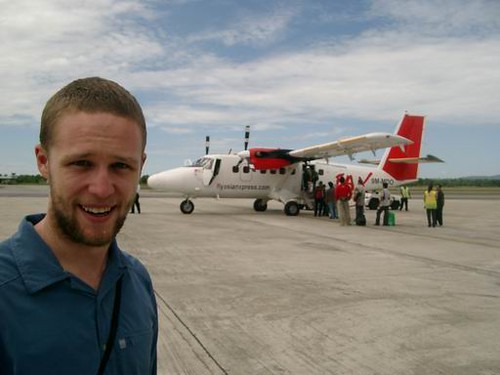 Boarding the 17 Seater Twin Otter bound for Bario (after making a stop to deliver supplies to another village).
 Nancy, our host in Bario.
Nancy runs a homestay at the end of the old airstrip in Bario. During our stay she served us a number of delicious meals, including some wild boar, as well as helping us orgaise a guide for our walk (and preparing for the 15 Australian high school students she was expecting the next day!).
The following morning we headed for Pa' Lungan, and the home of our guide Phillip Liang. Despite being assured that the path was very clear and it was impossible to get lost, we still managed to take a wrong turn through the first village. Luckily a friendly lady in a rice paddy pointed out our error and we were soon back on track (and feeling rather stupid having later seen the huge sign we walked straight past).
Phillip welcomed us into his home and then wandered off to knock some pomelos (like grpaefruit but the size of bowling balls) off a tree in the centre of the village. Quite a bit of pomelo later we were left to our own devices to wash (with a view from the washroom over the buffalo field) and relax. Over dinner Phillip told us of how every election poiticians come to their tiny village of 100 people, and every election they promise a road from Bario, but the road never gets built. Instead the local people have to bring in everything by Buffalo or by foot.
The irony is that they will probably get their road one day soon, but it will not be provided by the government. At this point in time logging roads reach within about 25 kilometers of Bario, and given the current rate of progress Pa' Lungan will get its road within a decade. This is not a prospect that Phillip and the people of Pa' Lungan are as keen on. Much of their livelihood stems from the jungle and a small farm that they maintain on the outskirts of the village. Logging will undoubtedly make many facets of their current livelihood untenable, but they have no other place to go (there are few parts of Malaysia more remote, and even if they could go there, they could not very well transplant their houses and farms).
Phillip's house is one of only two in town with a satellite dish, so in the evening half of the villlage takes up residence in his huge living area to watch Indonesian soap operas. Given our limited understanding of Indonesian and our even more limited interest in soap operas we opted for an early night.
The next morning we set out from Pa' Lungan into the jungle. Thoughout the day we forded streams on shaky log bridges, heard animals disappear at our noisy approach and got friendly with the blood sucking locals.
 The blood sucking locals; leeches. In the three days we spent in the jungle we would have plucked no fewer than 200 off our shoes, socks, feet, legs, stomachs, etc.
 No log bridge here!
On the final morning we headed back off into the jungle, this time to avoid the Indonesian military who have been known to ask for bribes before allowing travellers to re-enter Malaysia. No such difficulties at the military post on the Malaysian side of the border, the officer didn't even want to look at Erin's passport! Once we had crossed the border we rejoined the logging road, which runs all the way from the Malay coast line into the hills of Indonesian Kalimantan. In Ba Kelalan we discovered our flight had been cancelled, instead Phillip helped us locate a 4WD heading for Lawas and we said our farewells.
 Phillip with a possible glimpse of the future .
The 4WD, a diesel Hilux, had two padded bench seats in the tray with a canopy over the top, this is where we and the other two unfortunate passengers sat. Not far into our journey we discovered why Ba Kelalan still has an airstrip despite the advent of road access. Even though it is the 'dry season' in this part of Borneo, this simply means they get an average 300mm of rain a month instead of 500mm. Although it hadn't rained for a number of days the constant humidity makes the road very slow to dry out and we were frequently up to the axles in thick sticky mud.
At one point we approached a hill only to find the five vehicles in front of us stopped. Ahead was a steep hill covered in thick mud with a 4WD stranded about a third of the way up. Our driver stopped at the end of the queue and wandered up the hill to help (which involved throwing rocks, logs and anything else they could find over the road to form some kind of base). After about an hour of makeshift road improvements, interspersed with attempts at the hill by various vehicles and just as we thought we were headed back to Ba Kelalan, a vehicle eventually made it up the hill. One by one they climbed the hill and finally we were on our way again.
After a few hours we passed through the first logging settlement. If you can imagine the landscape around Queenstown in Tasmania you can get a feel for the landscape in the immediate vicinity of this town. All the houses were identical, obviously bought in on the back of trucks. Garbage and sewage appeared to be disposed of directly into the rather filthy river that ran beneath the rows of shacks.
It is pleasing to say that the rainforest was completely destroyed only immediately surrounding these settlements. But the string of log trucks that we passed endlessly on the way down to the coast would tend to suggest that trees are disappearing fast. Apparently only the largest trees are harvested to begin with, and then as virgin rainforest gets more inaccessible the loggers return for smaller and smaller specimens. The problem with this technique (or more like one of the many problems) is that forestry researchers suggest that ten smaller trees are killed for each one large tree that is removed, effecting far more damage than is evident from simply counting the number of logs removed.
 A log truck slid off the road, a dozen more wait for it to be removed so they can continue down to the coast. Where did your last piece of hardwood funiture come from?!
Finally, after six and a half hours in the tray of the hilux (and a rather unpleasant tropical downpour for the last 30 minutes) we arrived exhausted in Lawas. The flight we were supposed to have caught takes 40 minutes and costs less! We took the first hotel room we found, quickly got some dinner and collapsed.
The following morning we headed for Pa' Lungan, and the home of our guide Phillip Liang. Despite being assured that the path was very clear and it was impossible to get lost, we still managed to take a wrong turn through the first village. Luckily a friendly lady in a rice paddy pointed out our error and we were soon back on track (and feeling rather stupid having later seen the huge sign we walked straight past).
Phillip welcomed us into his home and then wandered off to knock some pomelos (like grpaefruit but the size of bowling balls) off a tree in the centre of the village. Quite a bit of pomelo later we were left to our own devices to wash (with a view from the washroom over the buffalo field) and relax. Over dinner Phillip told us of how every election poiticians come to their tiny village of 100 people, and every election they promise a road from Bario, but the road never gets built. Instead the local people have to bring in everything by Buffalo or by foot.
The irony is that they will probably get their road one day soon, but it will not be provided by the government. At this point in time logging roads reach within about 25 kilometers of Bario, and given the current rate of progress Pa' Lungan will get its road within a decade. This is not a prospect that Phillip and the people of Pa' Lungan are as keen on. Much of their livelihood stems from the jungle and a small farm that they maintain on the outskirts of the village. Logging will undoubtedly make many facets of their current livelihood untenable, but they have no other place to go (there are few parts of Malaysia more remote, and even if they could go there, they could not very well transplant their houses and farms).
Phillip's house is one of only two in town with a satellite dish, so in the evening half of the villlage takes up residence in his huge living area to watch Indonesian soap operas. Given our limited understanding of Indonesian and our even more limited interest in soap operas we opted for an early night.
The next morning we set out from Pa' Lungan into the jungle. Thoughout the day we forded streams on shaky log bridges, heard animals disappear at our noisy approach and got friendly with the blood sucking locals.
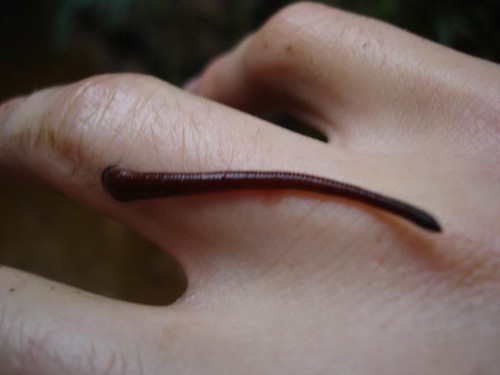 The blood sucking locals; leeches. In the three days we spent in the jungle we would have plucked no fewer than 200 off our shoes, socks, feet, legs, stomachs, etc.
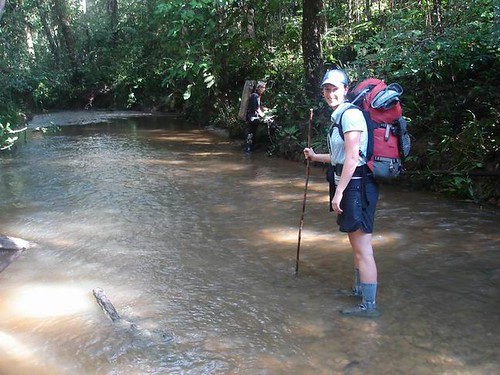 No log bridge here!
Late in the day we arrived at our destination, Long Repung, a hunting shelter on the banks of a river. Unfortunately the shelter was on the opposite bank and the bridge had been washed away. Phillip demonstrated the technique for dancing across a narrow slippery log, before we unelegantly crawled across.
 Phillip crossing the river.
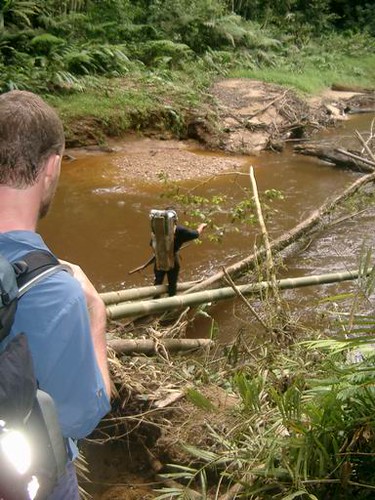 Phillip crossing the river.
The evening meals was rice and wheat drink as well as some ferns and chilli that Phillip collected from nearby. The evenings sleep on the hard floor with rats wasn't the best we've ever had...
Another days trekking and another hundred leeches saw us cross the border into Indonesian Kalimantan and to the town of Pa' Rupai. All the townships in the area are inhabited by people belonging to the Kelabit tribe. Modern borders have split the community, but they are more or less free to move between countries. However restrictions on employment and trade result in the Indonesian Kelabits being the poorer cousins. The longhouse we stayed at in Pa' Rupai was noticeably poorer than the more modern houses on the Malay side of the border, and far more people occupuied the one house.
That night we shared a meal with the village chief; rice, ferns and bamboo once more. And once again everyone turned up after dinner to watch soaps. Many of the villages expressed their disappointment to Phillip that they could not speak English so they could talk with us, another noticeable difference between the Malay an Indonesian sides of the border. Our attempt to communicate using the small Kelabit phrase seciton of our guide caused some amusement (but no actual communication)!
 Sharing a meal with Phillip and the village chief.
Another days trekking and another hundred leeches saw us cross the border into Indonesian Kalimantan and to the town of Pa' Rupai. All the townships in the area are inhabited by people belonging to the Kelabit tribe. Modern borders have split the community, but they are more or less free to move between countries. However restrictions on employment and trade result in the Indonesian Kelabits being the poorer cousins. The longhouse we stayed at in Pa' Rupai was noticeably poorer than the more modern houses on the Malay side of the border, and far more people occupuied the one house.
That night we shared a meal with the village chief; rice, ferns and bamboo once more. And once again everyone turned up after dinner to watch soaps. Many of the villages expressed their disappointment to Phillip that they could not speak English so they could talk with us, another noticeable difference between the Malay an Indonesian sides of the border. Our attempt to communicate using the small Kelabit phrase seciton of our guide caused some amusement (but no actual communication)!
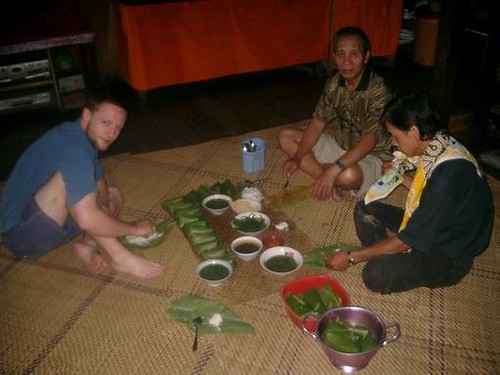 Sharing a meal with Phillip and the village chief.
On the final morning we headed back off into the jungle, this time to avoid the Indonesian military who have been known to ask for bribes before allowing travellers to re-enter Malaysia. No such difficulties at the military post on the Malaysian side of the border, the officer didn't even want to look at Erin's passport! Once we had crossed the border we rejoined the logging road, which runs all the way from the Malay coast line into the hills of Indonesian Kalimantan. In Ba Kelalan we discovered our flight had been cancelled, instead Phillip helped us locate a 4WD heading for Lawas and we said our farewells.
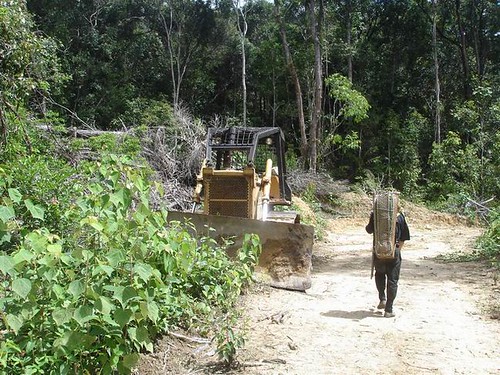 Phillip with a possible glimpse of the future .
The 4WD, a diesel Hilux, had two padded bench seats in the tray with a canopy over the top, this is where we and the other two unfortunate passengers sat. Not far into our journey we discovered why Ba Kelalan still has an airstrip despite the advent of road access. Even though it is the 'dry season' in this part of Borneo, this simply means they get an average 300mm of rain a month instead of 500mm. Although it hadn't rained for a number of days the constant humidity makes the road very slow to dry out and we were frequently up to the axles in thick sticky mud.
At one point we approached a hill only to find the five vehicles in front of us stopped. Ahead was a steep hill covered in thick mud with a 4WD stranded about a third of the way up. Our driver stopped at the end of the queue and wandered up the hill to help (which involved throwing rocks, logs and anything else they could find over the road to form some kind of base). After about an hour of makeshift road improvements, interspersed with attempts at the hill by various vehicles and just as we thought we were headed back to Ba Kelalan, a vehicle eventually made it up the hill. One by one they climbed the hill and finally we were on our way again.
After a few hours we passed through the first logging settlement. If you can imagine the landscape around Queenstown in Tasmania you can get a feel for the landscape in the immediate vicinity of this town. All the houses were identical, obviously bought in on the back of trucks. Garbage and sewage appeared to be disposed of directly into the rather filthy river that ran beneath the rows of shacks.
It is pleasing to say that the rainforest was completely destroyed only immediately surrounding these settlements. But the string of log trucks that we passed endlessly on the way down to the coast would tend to suggest that trees are disappearing fast. Apparently only the largest trees are harvested to begin with, and then as virgin rainforest gets more inaccessible the loggers return for smaller and smaller specimens. The problem with this technique (or more like one of the many problems) is that forestry researchers suggest that ten smaller trees are killed for each one large tree that is removed, effecting far more damage than is evident from simply counting the number of logs removed.
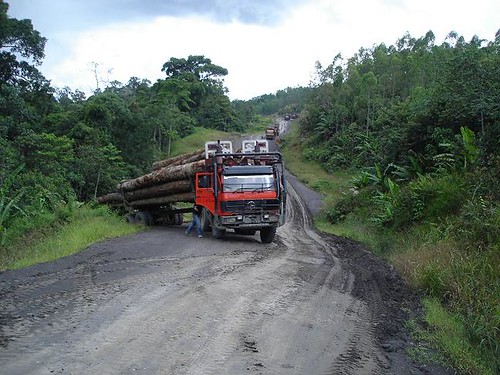 A log truck slid off the road, a dozen more wait for it to be removed so they can continue down to the coast. Where did your last piece of hardwood funiture come from?!
Finally, after six and a half hours in the tray of the hilux (and a rather unpleasant tropical downpour for the last 30 minutes) we arrived exhausted in Lawas. The flight we were supposed to have caught takes 40 minutes and costs less! We took the first hotel room we found, quickly got some dinner and collapsed.





 The atmosphere at the footy was great and it was nice being able to get beer in a can instead of the plastic cups you get at Telstra Dome.